Use It or Waive It
The Rule 12 waiver trap that costs 1Ls real points: personal jurisdiction, venue, process, and service must all go in your first Rule 12 motion or they are gone forever. Subject-matter jurisdiction is the one card that never expires — raisable at any time, even on appeal.
2026-08-14
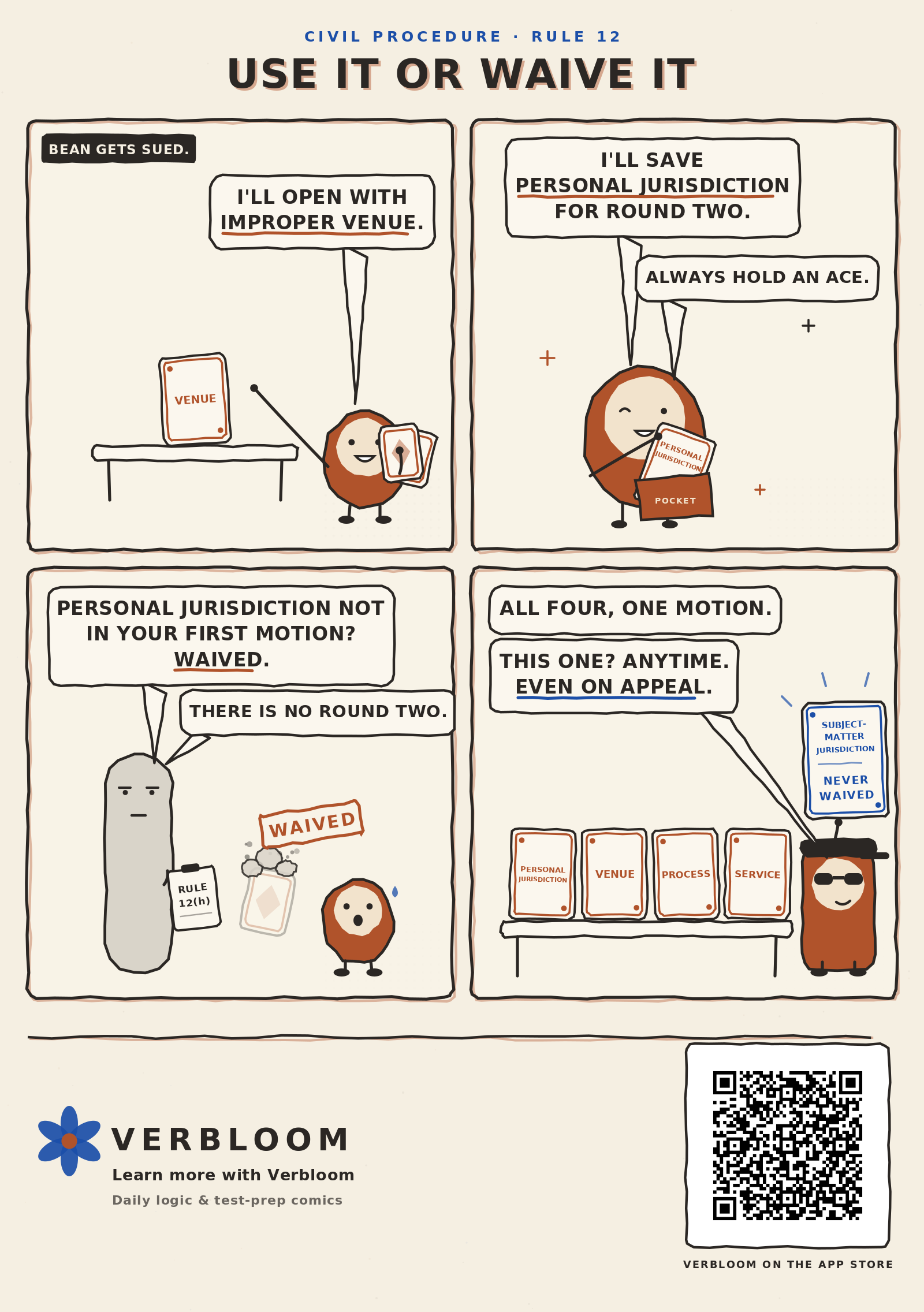
Rule 12 punishes strategy. The instinct every 1L has — hold a good defense back, spring it later when it will do more damage — is precisely the move that destroys it. Under Rule 12(g)(2), if you file a Rule 12 motion and leave out a defense that was available to you at the time, you cannot raise it in a second Rule 12 motion. Rule 12(h)(1) then finishes the job: the omitted defense is waived outright. There is no round two.
The defenses this destroys are the four procedural ones: lack of personal jurisdiction (12(b)(2)), improper venue (12(b)(3)), insufficient process (12(b)(4)), and insufficient service of process (12(b)(5)). These are the objections that say "you brought me to the wrong place, the wrong way" — and the drafters decided that if you actually cared about being hauled into the wrong court, you would say so immediately. Raise them together in your first Rule 12 motion, or include them in your responsive pleading if you file no motion at all. Split them across two filings and the second one is dead on arrival.
Not every defense is on that clock, and knowing which tier a defense sits in is the whole skill. Failure to state a claim (12(b)(6)), failure to join a required party (12(b)(7)), and failure to state a legal defense get a middle tier under Rule 12(h)(2): you can still raise them in any pleading, on a Rule 12(c) motion for judgment on the pleadings, or at trial — just not for the first time on appeal. Subject-matter jurisdiction sits alone at the top. Under Rule 12(h)(3), if the court determines at any time that it lacks subject-matter jurisdiction, it must dismiss the action. A party can raise it years in, the court can raise it on its own, and an appellate court can raise it after a full trial and a verdict. It is the only defense you are allowed to save.
So the exam-day move is the opposite of clever: front-load everything. Put every available 12(b) defense into one consolidated motion, because there is no penalty for raising a defense early and a fatal penalty for raising it late. The only card worth holding is the one that can never be taken away.
Key takeaways
- Rule 12(g)(2) bars a second Rule 12 motion raising any defense that was available and omitted from the first one.
- 12(b)(2)–(5) — personal jurisdiction, venue, process, service — are waived under 12(h)(1) if left out of your first Rule 12 motion or responsive pleading.
- 12(b)(6), 12(b)(7), and failure to state a legal defense survive longer under 12(h)(2): raisable in any pleading, on a 12(c) motion, or at trial — but not first on appeal.
- Subject-matter jurisdiction (12(b)(1)) is never waived. Under 12(h)(3) the court must dismiss whenever it discovers the defect — including sua sponte, including on appeal.
- Practical rule: consolidate every available defense into one motion. Early costs nothing; late costs everything.
Now try it for real
Battle the Mock Trial
Rule 12 only sticks once you have made the call under pressure. Play Mock Trial to argue procedural motions against a live opponent and find out which defenses you actually reach for — free, no signup.
Frequently asked questions
Which Rule 12 defenses are waived if you leave them out of your first motion?
The four procedural defenses in Rule 12(b)(2) through 12(b)(5): lack of personal jurisdiction, improper venue, insufficient process, and insufficient service of process. Under Rule 12(g)(2) you cannot raise them in a second Rule 12 motion, and Rule 12(h)(1) waives them entirely if you omitted them from a motion you already filed, or failed to put them in a responsive pleading or an amendment allowed as a matter of course under Rule 15(a)(1).
Can subject-matter jurisdiction ever be waived?
No. Rule 12(h)(3) provides that if the court determines at any time that it lacks subject-matter jurisdiction, it must dismiss the action. Because federal subject-matter jurisdiction is a limit on the court's constitutional and statutory power rather than a personal protection for the defendant, no party can consent to it or forfeit the objection. It can be raised by any party, by the court on its own motion, and for the first time on appeal — even after a full trial and a verdict.
What is the difference between Rule 12(h)(1) and Rule 12(h)(2)?
Rule 12(h)(1) is the hard waiver provision covering the four procedural defenses in 12(b)(2)–(5): miss the first opportunity and they are gone. Rule 12(h)(2) is a softer preservation rule covering failure to state a claim (12(b)(6)), failure to join a required party under Rule 19 (12(b)(7)), and failure to state a legal defense. Those three survive past the first motion and may be raised in any pleading permitted under Rule 7(a), by a Rule 12(c) motion for judgment on the pleadings, or at trial — but not for the first time on appeal.
Why can't I save a strong defense like personal jurisdiction for later?
Because Rule 12 was written specifically to stop that tactic. Rule 12(g)(2) consolidates the Rule 12 motion practice so a defendant cannot delay the case with successive motions, and Rule 12(h)(1) makes the consequence of omission automatic waiver rather than a discretionary sanction. Holding personal jurisdiction back for a second round does not preserve leverage — it forfeits the defense. The correct strategy is to consolidate every available defense into a single Rule 12 motion.
Get a comic like this daily
Verbloom on iPhone
One concept, drawn, every morning — plus full practice sets for the LSAT, GRE, and 1L doctrinal courses.
Download free →Send it to your section
Free to share and print
Print it, post it to your study group, put it in the course Discord. No signup, no watermark removal, no catch — just credit Verbloom.
Download print-quality PNG