Sufficient vs. Necessary
The single distinction behind half of LSAT conditional questions: a sufficient condition guarantees the result, a necessary one is merely required. Learn the indicator words, the “unless / until / without / except” trap, and how to spot the mistaken reversal and negation traps on sight.
2026-06-14
Half of LSAT conditional logic comes down to one question: is this condition enough to guarantee the result, or just required for it? That is the whole difference between sufficient and necessary — and the test punishes anyone who blurs the two.
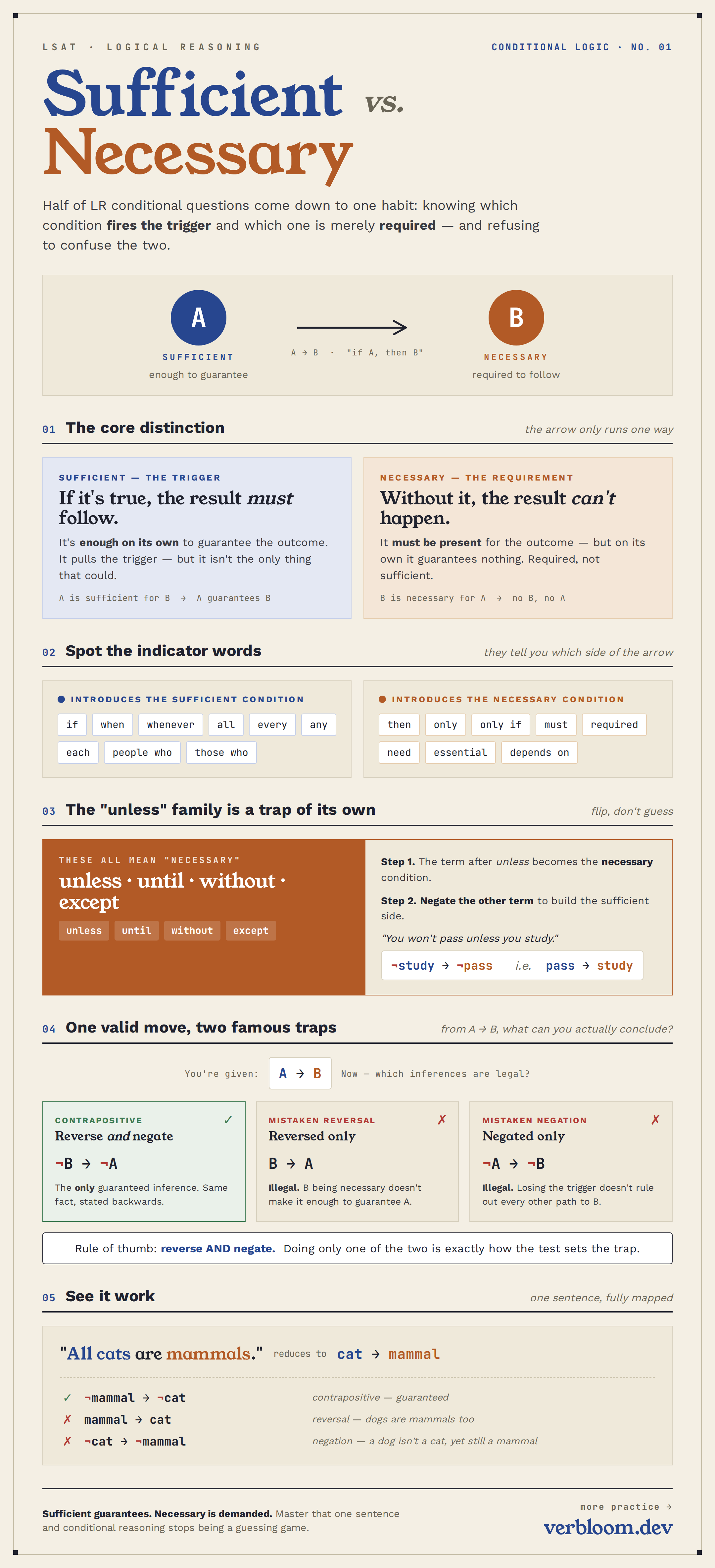
A sufficient condition is enough on its own: if it is true, the result must follow. A necessary condition is required but not enough on its own: the result cannot happen without it, yet having it does not guarantee anything. "If A then B" makes A sufficient for B and B necessary for A — and the arrow only runs one way.
This comic distills that distinction into one picture: the indicator words that flag each side, the "unless / until / without / except" group that always introduces the necessary condition, and the two traps the LSAT runs over and over — the mistaken reversal (B therefore A) and the mistaken negation (not A therefore not B).
Key takeaways
- Sufficient = enough to guarantee it. Necessary = required for it, but not enough by itself.
- "If," "when," "all," and "every" introduce the sufficient condition; "only," "only if," "requires," and "must" introduce the necessary one.
- "Unless," "until," "without," and "except" all introduce a necessary condition — negate the other side and read it as the sufficient trigger.
- Mistaken reversal (B → A) and mistaken negation (not A → not B) are wrong; only the contrapositive (not B → not A) preserves the logic.
Now try it for real
Battle the Flaw Monster
Confusing necessary and sufficient is the most common flaw on the LSAT. Battle the Flaw Monster to drill spotting the mistaken reversal and negation under pressure — free, no signup.
Frequently asked questions
What is the difference between a necessary and a sufficient condition on the LSAT?
A sufficient condition is enough on its own to guarantee the result — if it is true, the result must follow. A necessary condition is required for the result but not enough by itself: the result cannot occur without it, yet having it guarantees nothing. In "If A then B," A is sufficient for B and B is necessary for A.
Which words signal a necessary condition?
"Only," "only if," "requires," "must," and "needs" all introduce the necessary condition. The group "unless," "until," "without," and "except" also introduces a necessary condition — negate the other part of the sentence and treat it as the sufficient trigger.
What are the mistaken reversal and mistaken negation?
Given "A → B," the mistaken reversal wrongly concludes "B → A," and the mistaken negation wrongly concludes "not A → not B." Both are invalid. The only valid inference is the contrapositive: "not B → not A."
Get a comic like this daily
Verbloom on iPhone
One concept, drawn, every morning — plus full practice sets for the LSAT, GRE, and 1L doctrinal courses.
Download free →Send it to your section
Free to share and print
Print it, post it to your study group, put it in the course Discord. No signup, no watermark removal, no catch — just credit Verbloom.
Download print-quality PNG