Think like the test, not around it.
The LSAT® isn’t testing what you’ve memorized — it’s testing how you think. So you’ll drill the five skills that actually move your LR score (conditional logic, flaws, assumptions, strengthen/weaken, and parallel reasoning), and every answer comes with a plain-English why — not just a letter.
Or master Reading Comprehension — also free- Explanation after every question
- Realistic LSAT®-style questions
- Difficulty adapts as you improve
Students who explained their wrong answers out loud improved more than students who only reread the explanations. So saying your reasoning out loud must cause LSAT improvement.
The argument depends on which assumption?
Why
The argument jumps from correlation to causation. It has to assume no third factor produced both the out-loud explaining and the improvement.
A real Verbloom question — every answer is explained, not just scored.
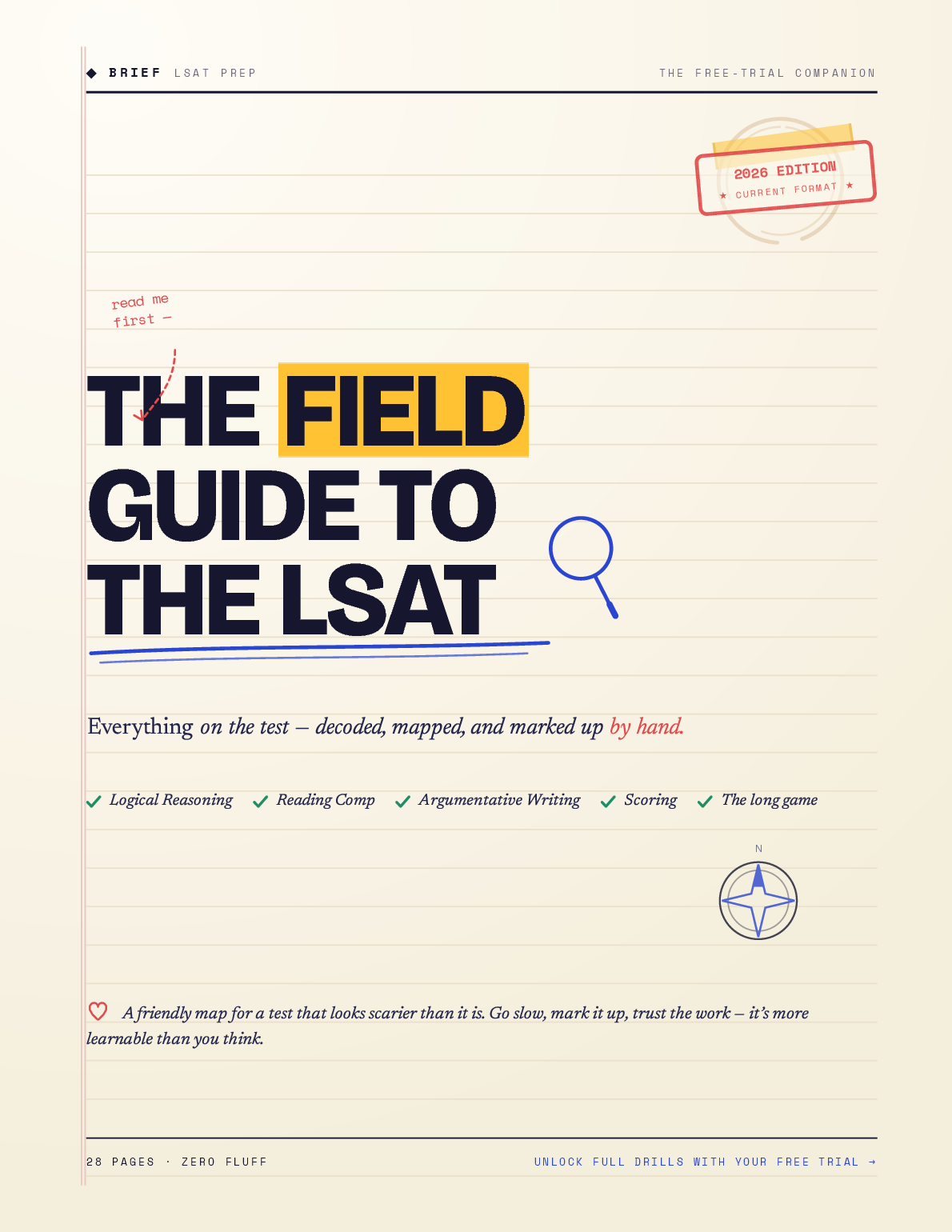
Verbloom's Guide to the LSAT®
Everything on the test — Logical Reasoning, Reading Comp, argumentative writing, and scoring — decoded and marked up by hand. Read the first 10 pages free; start a free trial to unlock the rest.
Everything Logical Reasoning tests
Five skills account for most LR questions. Verbloom drills each one with worked reasoning — not just an answer key.
Conditional logic, made visual
If/then, only-if, unless, and chained conditionals — diagrammed step by step, so contrapositives and inferences stop being guesswork.
Flaw recognition
Correlation-vs-causation, false analogy, circular reasoning, and 20+ named flaws you’ll spot on sight.
Assumptions
Find what an argument silently depends on — necessary and sufficient assumptions.
Strengthen & weaken
Judge what evidence actually moves an argument — the skill LR tests most.
178
LSAT score the founder earned
Built by a 99th-percentile scorer — not a publishing house or a marketing team.
$15
per month, after the trial
A fraction of one hour with a private tutor, or a traditional prep course. $12.50 a month if you pay yearly.
14 days
free — and the games are always free
Try the diagnostics and quizzes with no card before you ever subscribe.
Try a real lesson, free
Watch the first lesson, then answer three questions — no account needed.
Free lesson preview
See how Verbloom teaches
Press play to watch a real Verbloom lesson — Necessary vs. Sufficient Assumptions — then try 3 starter questions before creating an account.
What students say
Unsolicited messages from LSAT students, used with their permission. Their words, their numbers.
76–85% → 100%
accuracy on questions attempted, in a timed section
“Prior to joining your platform, my timed sections (questions attempted) were averaging 76%–85%. I've been drilling and studying for a year… Today, after watching a total of ~10 videos and five blog pages in the last few weeks, I hit my first milestone: 100% accuracy on questions attempted (88% overall). This is huge for me — and it was 100% because of your content.”
Erin M.
LSAT student · one year of self-study · goal 170
“The Verbloom app has really helped me study throughout the day — it's made studying a lot easier.”
Akito
LSAT student · active Verbloom app user
Start your free 14-day trial
Then $15/month, or $150/year if you pay yearly. Cancel anytime from your account. One account covers every exam.
Then $15/month
Same 14-day trial either way. Two months free when you pay yearly.
Have a promo code?
Create an account first, then start your trial so Verbloom recognizes your access across devices.
Study on the train, not just at your desk
The full app, drills, and diagnostics — in your pocket. One tap and you are studying.
Frequently asked questions
What LSAT skills does Verbloom cover?
Verbloom covers the core Logical Reasoning skills: conditional logic (if/then, only if, unless, contrapositives), flaw recognition (correlation vs. causation, false analogies, circular reasoning, necessary vs. sufficient, ad hominem, and more), necessary and sufficient assumptions, strengthen/weaken questions, and LSAT vocabulary.
How is Verbloom different from Kaplan, Princeton Review, or 7Sage?
Verbloom is built by someone who scored 178 — not a publishing company. Every explanation is written to teach the underlying reasoning pattern, not just the right answer. It is also a fraction of the cost.
Is there a free trial?
Yes. You get 14 days free before being charged. Cancel any time from your account settings before the trial ends and you will not be billed.
How much does Verbloom cost?
Verbloom is $15/month after the 14-day free trial, or $150/year if you pay yearly — two months free. That is less than the cost of one hour with a private LSAT tutor.
What is conditional logic and why is it so important for the LSAT?
Conditional logic — if/then statements and their valid inferences — underlies a large portion of LSAT Logical Reasoning questions. Mastering contrapositives, sufficient conditions, and necessary conditions is essential for questions involving assumptions, necessary/sufficient flaws, and many flaw question types.
Can Verbloom help with LSAT reading comprehension?
Verbloom focuses primarily on Logical Reasoning skills — the argument-based reasoning that underlies both LR and RC passages. Strong conditional reasoning and argument-structure skills transfer directly to LSAT Reading Comprehension.
How do I cancel my subscription?
You can cancel at any time using the 'Manage subscription' button in the app, or by emailing verbloom7@gmail.com. You will retain access through the end of your billing period.